

Candle Safety
NEVER LEAVE A BURNING CANDLE UNATTENDED!!
Keep all burning candles away from children and pets.
Position candles away from flammable objects, especially above the candle.
Always burn candles on a heat resistant surface. Candle holders may become hot and cause damage. Be sure the surface is large enough to catch any wax that may drip. There are NO dripless candles!!
Burning Tips
Keep your wicks trimmed or they will tend to smoke (or mushroom). Trim after melt pool hardens.
Burn candles away from drafts; they can cause your candle to burn unevenly, drip, and smoke.
Keep candles out of strong light, it will make the color fade. Summer sun will cause candles to soften, sag, and sometimes melt to a puddle.
Store candles in foil or plastic to conserve their scent and keep the wick from absorbing moisture. Refrigerate - they will burn longer.
To extend candle life, burn votives until melt pool is approx. 1/4" deep, pillars until melt pool approaches edge then extinguish - when melt pool hardens, relight
Clean Up Tips
Wax on a hard surface will just scrape off after it has cooled.
Wax on clothing or cloth:
Pour hot water through it and the wax will mostly melt away with the water.
Place the cloth in the freezer, or hold an ice cube to the wax. When it is very cold, chip off any large pieces of wax.
Rub liquid dish soap into the area and wash as indicated for the fabric.
Wax in your carpet: let it harden and rub an ice cube on it to make it brittle, then scrape it out. Some wax will remain, and if it's a noticeable color, you can then melt it with a hot, wet cloth or use a warm iron (protect iron with foil) through a wet cloth and most of the color will sponge up with repeated treatments.
Wax built up on candle holders:
Place in the freezer, chip off wax.
Heat glass or metal holders in a pan (start with cold water - glass may crack or shatter if it isn't preheated). Heat slowly till
wax melts, remove holder. Pour hot water over it until the residue is gone. Finally, wash as you normally would in a
dishwasher or by hand.
Rubbing alcohol will often remove the black soot build up around the tops of holders.
What Are Wick Mushrooms?
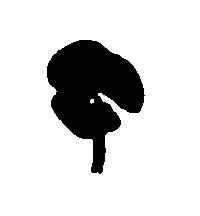
Mushrooms are unburned carbon (smoke) deposited during the burning of a candle. Over time it can build up to an unsightly (??) blob on the end of the wick. The mushroom usually won't prevent a candle from burning well.
Scientific cause
If there is more melted wax than can be fully combusted, a mushroom will form. The wire core, in the wick used in container candles to keep the wick upright, is in the coolest part of the flame - attracting the carbon. The wick, scent, dye, bees wax and all other ingredients used in a wax formula to make candles softer, harder, glossier, etc. interact. The more complex the wax formula the more prone the candle is to mushrooming
OR maybe its Magic
The mushrooms generated are just a visual expression of the spells that are molded into every candle to produce the feelings of love, sensuality, peace, and tranquillity normally associated with the burning of candles.
If the mushroom effects the flame configuration of your candle, or your sensibility
Just remove it!!
1) Blow out the flame.
2) Wait for the melt pool to harden (Its easier on the fingers and keeps residue from sinking in to the wax)
3) Cut off the wick just below the mushroom and dump residue.
4) Relight the candle, kick back, and enjoy.
Worried about lead wick candles?
Claim: "All candle wicks with a wire in the middle contain lead"
Truth: Wrong! Lead core wicks were discontinued and have not been manufactured in the United States for several years. The wire cores used today are most commonly made of Zinc, and some are Tin, both of which are safe to burn and only contain trace elements of lead impurities. Zinc has a maximum Lead content is 0.004%
Note: Any nonferrous metal will have similar trace elements of Lead.
Claim: "Any candle with metal in the wick is unsafe to burn"
Truth: Not true! Research shows that zinc and tin wicks are safe and pass the EPA's air quality tests. A person would have to burn over 3,000 candles with zinc wicks for four hours a day to exceed the EPA's air quality standard for lead.
Want more information? http://www.leadfreecandles.org/
New items added often - so come back soon
 |
 |
 |
 |
 |
 |